
Waking up with neck pain can be frustrating, especially when you felt fine the night before. You may notice stiffness when turning your head, soreness at the base of the skull, pain into your shoulders, or a sharp catch when you try to move.
In many cases, neck pain after sleeping comes from a combination of pillow position, sleep posture, muscle tension, and how your neck was supported overnight. One awkward night can irritate the joints and muscles in the neck. But if it keeps happening, there may be an underlying posture, mobility, or nerve issue that needs a closer look.
Morning neck pain is common, but it should not become your normal.
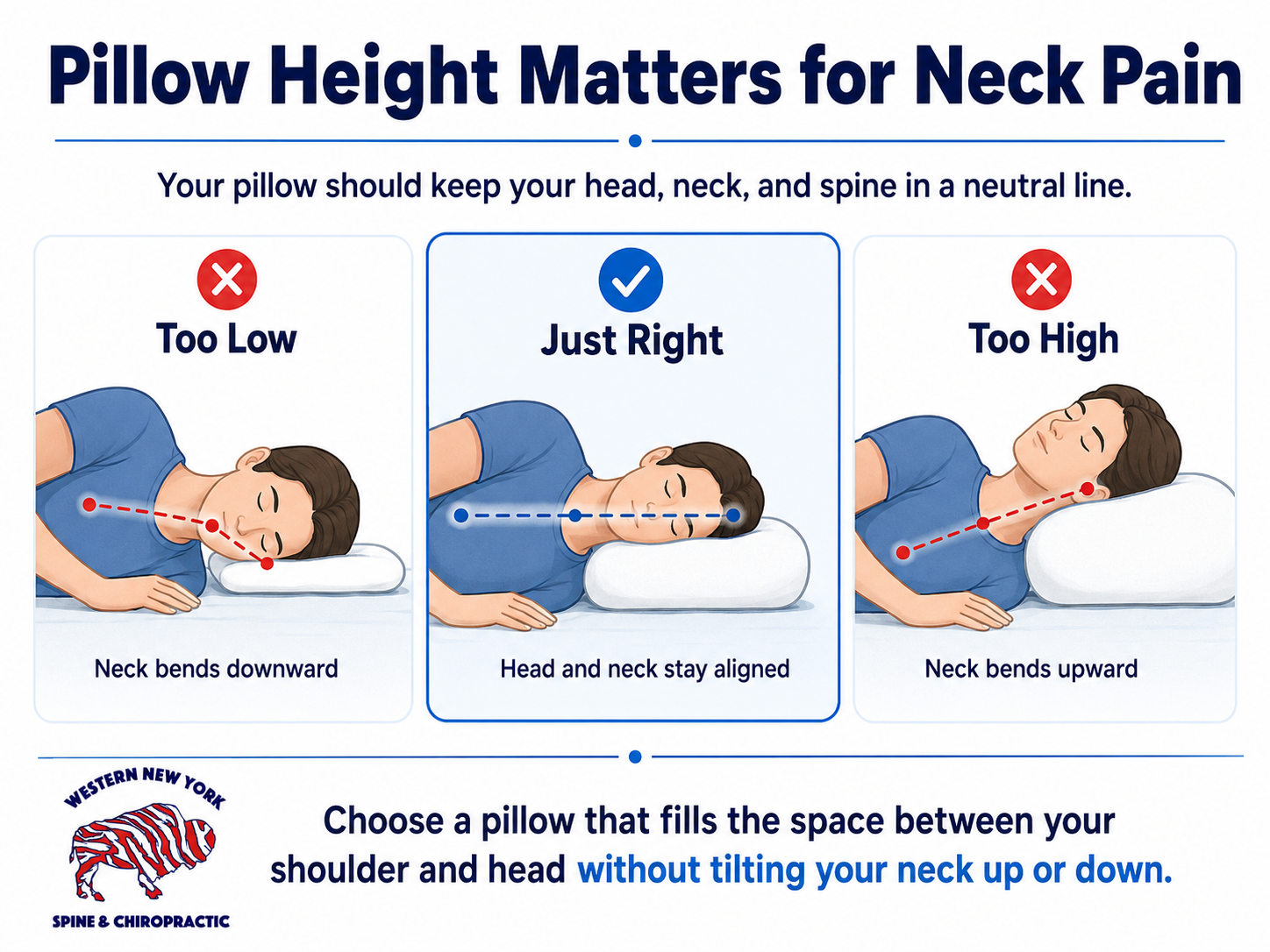
Your neck has to support your head all day, and it still needs support while you sleep. If your pillow is too high, too flat, too firm, or too soft, your neck may spend hours bent to one side, pushed forward, or tilted backward.
That position can strain the muscles, joints, ligaments, and nerves in the neck. Mayo Clinic notes that neck pain can be related to muscle strain, worn joints, nerve compression, injuries, and other causes. Cleveland Clinic also notes that neck stiffness is often temporary and can happen after overusing your neck or sleeping in an unusual position.
The issue is not always the pillow by itself. It is usually the position your pillow creates.
The way your neck feels when you wake up can offer clues about whether the issue may be related to pillow height, sleep position, posture, muscle tension, or nerve irritation.
A good pillow should keep your head and neck in a neutral position. That means your neck is not bent sharply upward, dropped too far downward, or twisted to one side.
Cleveland Clinic explains that a proper pillow should keep the neck parallel to the mattress instead of bent up, down, or sideways. This is why the best pillow is not the same for everyone. A side sleeper, back sleeper, and stomach sleeper may all need different support.
If your pillow is too high, your head may be pushed forward all night. If it is too low, your neck may sag backward or sideways. Either way, the muscles around the neck have to work harder, and the joints may become irritated.
A pillow issue may be more likely if your pain is worse first thing in the morning, your neck feels better as the day goes on, you wake up with stiffness on one side, you frequently adjust your pillow at night, or you also wake up with shoulder pain or headaches.
The goal is not to find the most expensive pillow. The goal is to find one that keeps your head, neck, and shoulders lined up.
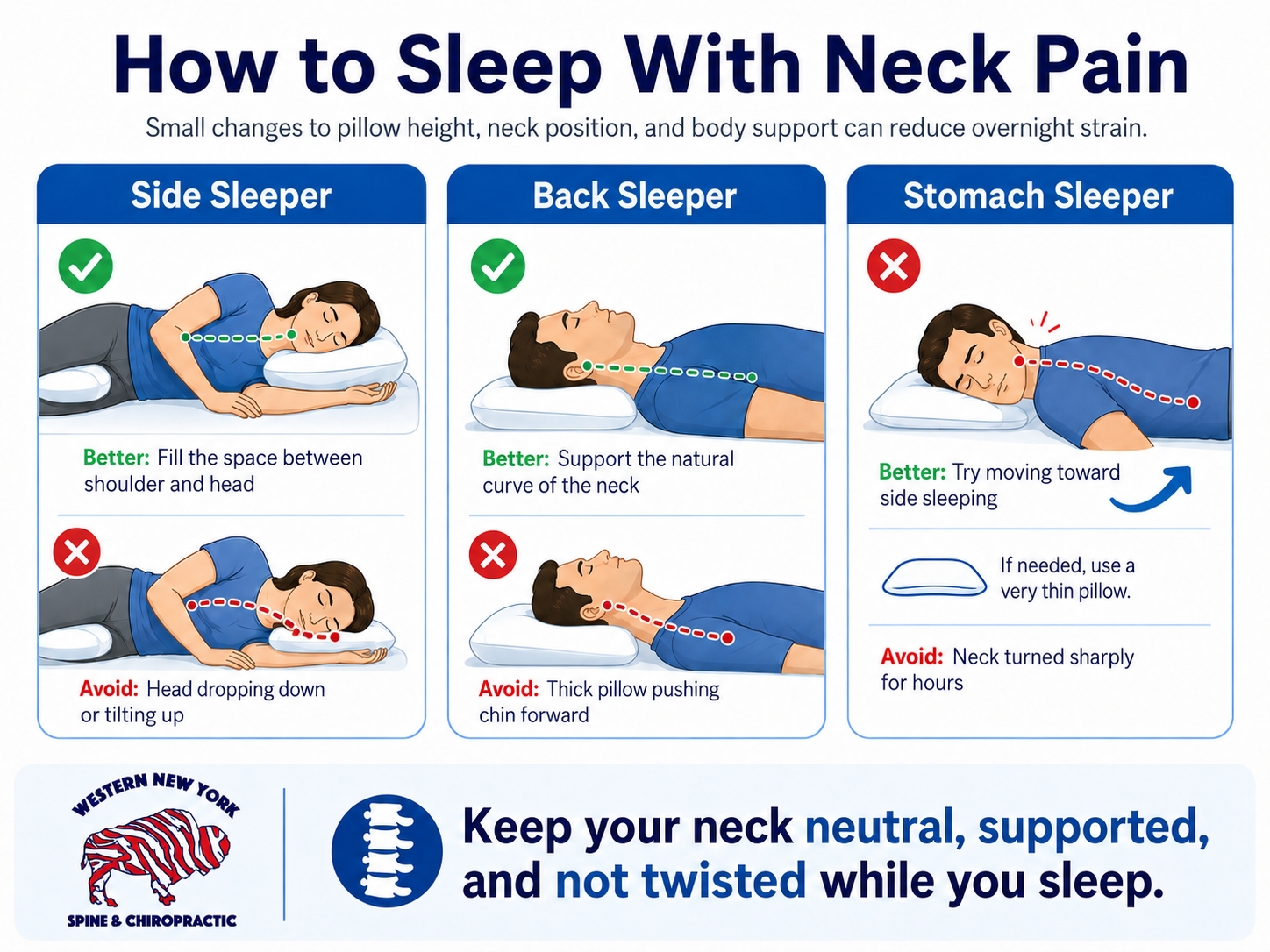
Side sleeping can be a good position for neck pain, but only if the pillow fills the space between your shoulder and your head.
If the pillow is too thin, your head may drop downward. If the pillow is too thick, your head may tilt upward. Both positions can strain the neck overnight.
A side sleeper usually needs a pillow that keeps the nose, chin, neck, and chest lined up. Your head should not be angled toward the mattress or pushed toward the ceiling.
A simple way to think about it: your neck should look straight from the front, your head should not dip toward the bed, your shoulder should not be jammed under your neck, and your pillow should support the space between your neck and shoulder.
Back sleeping is often easier on the neck than stomach sleeping, but the pillow still matters.
If a back sleeper uses a pillow that is too thick, the head can be pushed forward all night. That can place the neck in a flexed position and make the muscles at the back of the neck work harder. If the pillow is too flat, the head may fall backward and the neck may feel unsupported.
For many back sleepers, the goal is a lower pillow that supports the natural curve of the neck without forcing the chin toward the chest. Some people do better with a thinner pillow, a contoured neck pillow, or a small towel roll under the neck.
Support should feel gentle and even. Do not force your neck into a dramatic curve.
Stomach sleeping is one of the most common sleep positions that can irritate the neck. When you sleep on your stomach, your head usually has to turn to one side so you can breathe. That means your neck may stay rotated for hours.
That prolonged twist can irritate the joints and muscles on one side of the neck. It may also contribute to upper back tightness, shoulder discomfort, or headaches at the base of the skull.
If you often wake up with one-sided neck pain, stomach sleeping may be part of the problem. You do not always have to change everything overnight. Even moving from full stomach sleeping to a more angled side position can reduce how far your neck has to turn.
Neck pain after sleeping is not always caused by sleep alone. Sometimes your sleep position is only the final trigger.
If you spend hours looking down at a phone, leaning toward a computer, driving, or sitting with rounded shoulders, the muscles in your neck and upper back may already be irritated before you go to bed. Then, a poor pillow position or awkward sleeping posture can make that irritation worse.
This is especially common with poor posture and forward head posture. Forward head posture happens when your head sits in front of your shoulders instead of stacked over them. Over time, this can overload the muscles at the base of the skull, tighten the shoulders, and increase strain through the neck.
Signs posture may be contributing include neck pain that builds throughout the workday, tight shoulders, headaches after screen time, stiffness after driving, and morning pain that improves once you move around.
Changing your pillow may help, but it may not fully solve the problem if your daily posture and neck mechanics are also contributing. For more on this connection, read Can Poor Posture Cause Headaches? or learn about postural correction therapy.
Sometimes people wake up with a neck spasm or strain. This can feel sudden, sharp, and limiting. You may turn your head and feel a catch, or you may feel like your neck is locked up.
A strain or spasm can happen from sleeping with the neck twisted, using an unsupportive pillow, clenching the jaw, stress-related tension, overuse from the day before, or a quick movement when getting out of bed.
Stress can also show up physically. Many people carry tension in the jaw, neck, shoulders, and upper back without realizing it. If you clench your jaw, grind your teeth, sleep with your shoulders shrugged, or wake up feeling tense, stress may be contributing to your neck pain.
This type of pain may feel like tightness at the base of the skull, soreness in the jaw or temples, shoulder tension, morning headaches, or a dull ache that improves after a hot shower or gentle movement.
Not all morning neck pain is muscular. Sometimes pain after sleeping is related to irritation in the joints, discs, or nerves of the neck.
This is more likely if your symptoms travel beyond the neck. Pay closer attention if you have pain traveling into the shoulder, arm, or hand; numbness or tingling; weakness in the arm or hand; burning or electrical pain; or pain that keeps coming back in the same pattern.
These symptoms do not automatically mean something serious is happening, but they are a sign that the issue should be looked at more carefully. If you think a nerve may be involved, you may also want to read Can a Pinched Nerve Heal on Its Own? or learn more about pinched nerve symptoms.
If your pain is mild and there are no concerning symptoms, start with simple steps. Try gentle neck movement instead of forcing a deep stretch, heat for tightness or stiffness, ice if the pain feels sharp or inflamed, avoiding stomach sleeping, adjusting your pillow height, and taking breaks from phone and computer posture.
The goal is to keep the neck moving comfortably without pushing into sharp pain. Avoid aggressive stretching if your neck feels locked, severely painful, or if symptoms are traveling into your arm. More force is not always better.
You should consider seeing a chiropractor if your neck pain keeps returning, lasts more than a few days, or starts affecting your normal routine.
It may be time to schedule an evaluation if you wake up with neck pain regularly, have frequent stiffness or limited range of motion, feel pain spreading into your shoulders or arm, have headaches with neck tightness, keep changing pillows but the pain comes back, or feel numbness, tingling, or weakness.
NHS recommends seeing a GP if neck pain or stiffness does not go away after a few weeks, pain medicine has not helped, you are worried about the pain, or you have symptoms such as pins and needles or a cold arm.
At WNY Spine & Chiropractic, neck pain care may include a posture and movement evaluation, muscle and joint assessment, spinal manipulation when appropriate, manual therapy for tight muscles and soft tissue, posture guidance, and home recommendations. Some patients may also benefit from therapies such as interferential stimulation therapy, depending on the symptoms and exam findings.
If you are looking for a broader overview of treatment options, read Neck Pain Treatment in Buffalo, NY: What Actually Helps.
Most neck pain after sleeping is not an emergency. However, neck pain should be taken seriously if it follows a major injury or appears with symptoms that may suggest a more urgent medical issue.
Most neck pain after sleeping is not an emergency. But some symptoms should be taken seriously.
Get urgent medical care if neck pain happens after a major fall, accident, or injury, or if it comes with symptoms such as fever, severe headache, confusion, trouble walking, loss of balance, weakness, numbness or tingling in the face, arm, or leg, chest pain, trouble speaking, vision changes, or loss of bladder or bowel control.
Mayo Clinic recommends emergency medical care for severe neck pain after an injury and contacting a healthcare professional when neck pain is very painful, does not improve after a few days, spreads into the arms or legs, or comes with headache, numbness, weakness, or tingling.
Your neck may hurt after sleeping because of pillow height, sleeping position, muscle tension, poor posture, stress, joint stiffness, or nerve irritation.
An occasional stiff neck may improve with gentle movement and a better sleep setup. But recurring morning neck pain is a sign that something may need to change.
If you wake up with neck pain often, have headaches with neck tension, or feel pain traveling into your shoulder or arm, WNY Spine & Chiropractic can help evaluate what may be causing the problem and recommend a care plan based on your symptoms.
Waking up with neck pain? Schedule an appointment with WNY Spine & Chiropractic in Buffalo, NY to find out what may be contributing to your symptoms.